Merry Lepper didn’t exactly set out to be a running pioneer. But somewhere along the way, she became the first known woman to finish a road marathon in the United States.
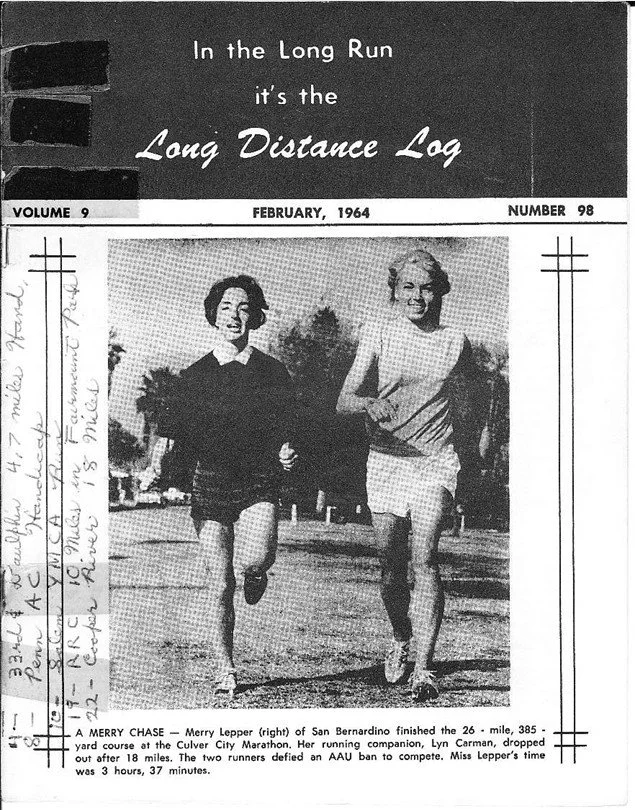
Merry started running as a child because she loved being out on the trails, in the wilderness. Her father, George, a former sprinter and a fan of the sport, gave her no reason to set limits on herself. “He pretty much never said, ‘Well, you can’t do that because you’re a girl,’” Merry says.
After several moves, the family settled in San Bernardino, outside of Los Angeles. Uncharacteristically for the era, San Bernardino High School had a girls’ track team. Merry competed in the 400 and 800 meters. But it was over the much longer distances that she truly felt alive. “I like to relax and enjoy myself—enjoy the fresh air and the athleticism of it,” she says.
After graduating and a short stint at the University of Kentucky, Merry moved back home to attend San Bernardino Valley College. One day, she was walking around on campus when she saw a group of runners. She perked up—she’d missed being on a team. And when she saw a woman running among the men, she knew she’d found a way back to the sport.
She asked the woman, Lyn Carman, if she could train with the group. Lyn enthusiastically agreed. Her husband, Bob, was a physics and math professor and the school’s cross-country coach. “You have to call him a genius,” Merry says, noting the piles of books and New Yorker magazines around the house. And, like Merry’s father, Bob saw no need to hold women back.
Most days, Merry ran about 5 miles or so, alone or with Lyn. On Sundays, the whole group would do long runs of up to 20 miles on the hills around Riverside, California. The men and women not only stayed together on the run, but were also friends outside of it, often meeting up for dinner at the Carman’s after classes. “They would talk about famous runners,” Merry says, “how they trained and how wonderful they were, and everybody would get inspired for the next workout.”
Lyn and Merry frequently raced at shorter distances, mostly on the hills and trails of southern California. At one of those events—a cross-country race in the fall of 1963—Merry first met Julia Chase-Brand, who two years earlier had defied the Amateur Athletic Union’s ban on women in road races to compete in the Manchester Road Race.
Though she didn’t quite realize it yet, Merry would soon do the same.
During their training, Lyn told Merry she dreamed of being the first American woman to run the marathon. (Arlene Pieper Stine was the first U.S. woman to run a sanctioned marathon in 1959 at the Pike’s Peak Marathon, but her feat was little-known at the time, and often categorized differently because it’s a mountain race.)
And soon enough, Lyn and Bob set their sights on the Western Hemispheres Marathon in Culver City, a race Bob had won in a course-record time in 1960. “I didn’t really know too much about the marathon. It was a big, long race,” Merry says. “I figured, if [Lyn] was going to do it, I’d go along for the kicks, and I’d run as far as I could, and then bow out if I needed to.”
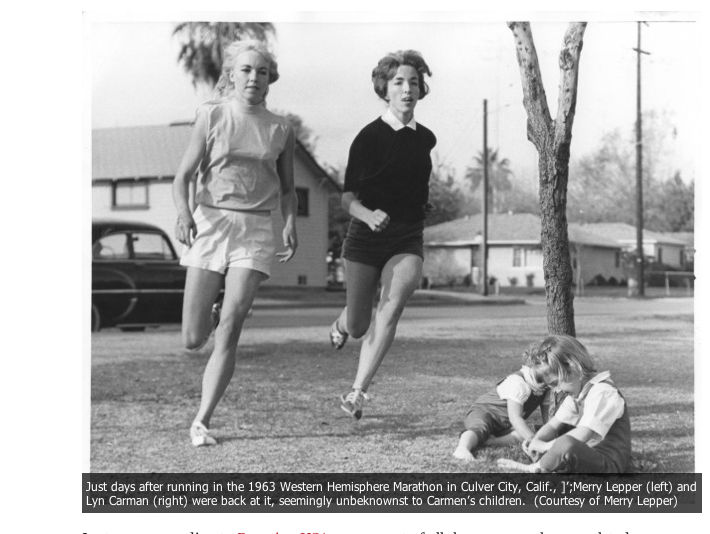
The day of the race, Merry didn’t even tell her parents exactly what she was doing. She casually mentioned that she was going to a race with the Carmans in Los Angeles, something she did frequently. She also didn’t eat breakfast beforehand. On the ride over, Lyn told her she needed something in her stomach for such a long distance and offered her a Baby Ruth candy bar.
Once they arrived, the two hung back at the start, out of view of the officials (although some, who knew them from other local races, were supportive). They didn’t begin until after the men did. But before too long, Lyn caught up to some of the guys, while Merry held back at a slower but steady pace.
At one point, Lyn got into an altercation with race officials, as sportswriter David Davis writes in his book Marathon Crasher: The Life and Times of Merry Lepper, the First American Woman to Run a Marathon. Although Merry was too far back to see the incident, she faced a challenge of her own when a car nearly collided with her. She had to sit down on the curb for about 10 minutes until her racing heart slowed enough to continue.
Eventually, Merry caught up to Lyn, and the two ran together for 5 to 10 minutes. To Merry’s shock, Lyn said she was so tired she couldn’t keep going. “I kept saying, ‘You can’t quit. It’s your dream,’” Merry says. “But she just felt really terrible, and she hadn’t had anything to drink. She was going to quit, and there wasn’t anything I could do.”
Merry, meanwhile, was feeling fine. So she continued, in part because of those who believed she couldn’t. “I’d had some catcalls from passing cars … like, ‘Hey lady, why don’t you quit?’ ‘Oh no, it’s a girl. Look at that! How funny,’ things like that,” she says. “So if I had quit, I would have been buying into their expectations.”
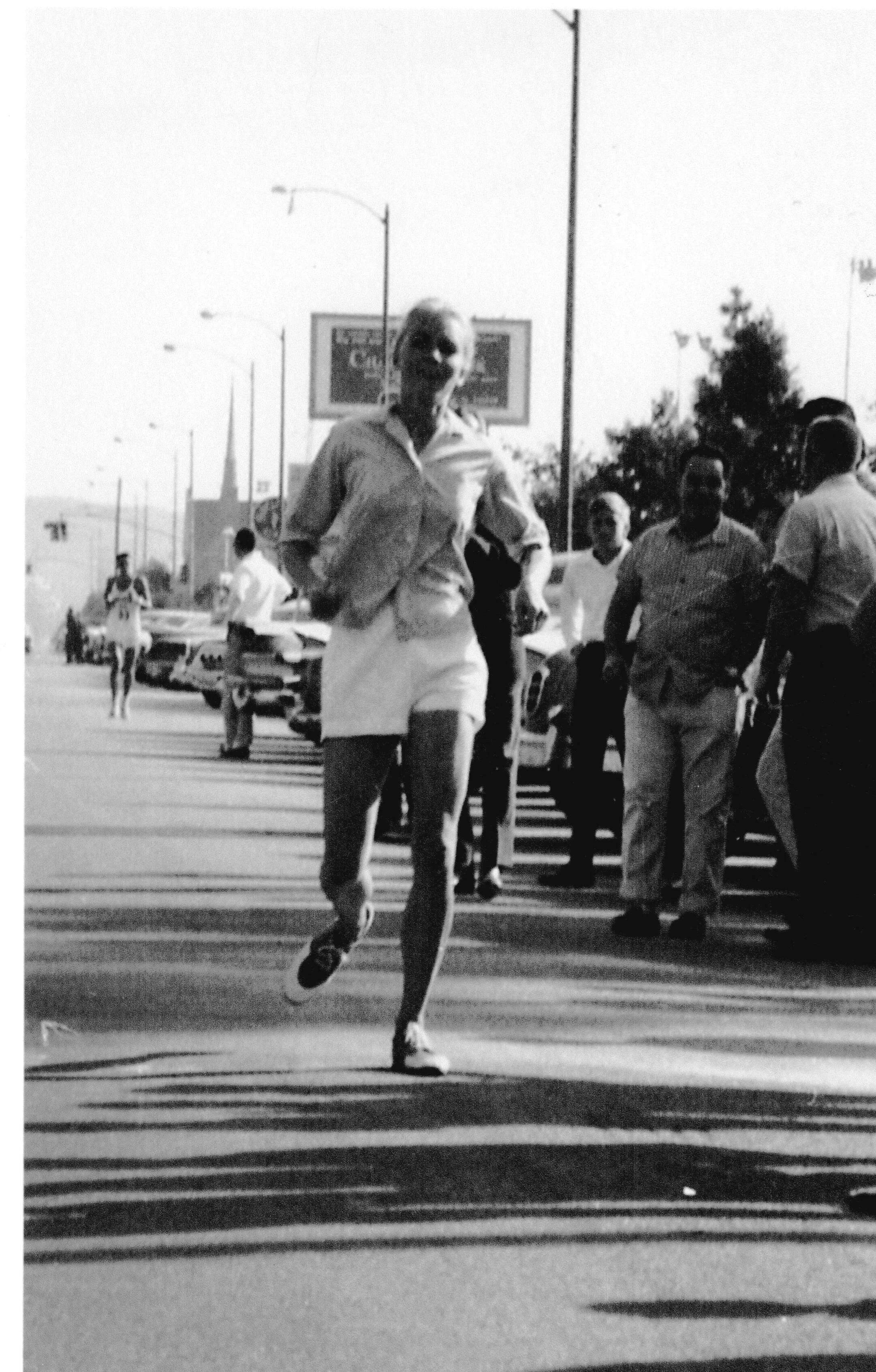
She arrived at the finish line, crossing in a time of three hours and 37 minutes, to little fanfare. Lyn and Julia, who’d been traveling the course with a friend in a Volkswagen bus, greeted her there and helped her back into her sweats (she’d been running in her usual gym shorts and button-down blouse). Another male friend from the running group gave her a ride home.
Lyn later called the San Bernardino Sun to tell them about Merry’s feat; her uncle saw the resulting article, which is how her family learned she was now a marathoner.
Not long after the race, Merry moved on to college at UC Davis. She kept running, aiming to keep the endurance to cover 5 miles, but never finished another marathon. Life took her many other places, including, eventually, into the career she’d long dreamed of, as a veterinarian. For years, she hesitated to talk much about her marathoning past, in part because of mixed feelings about finishing when Lyn couldn’t.
But finally, years later, her accomplishments would be more fully recognized. Davis wrote his book in 2012. Largely due to his efforts, Culver City honored Merry in 2013, celebrating the 50th anniversary of her finish. She’s also featured in Amby Burfoot’s 2016 book First Ladies of Running: 22 Inspiring Profiles of the Rebels, Rule Breakers, and Visionaries Who Changed the Sport Forever and wrote her own powerful piece, 26.2 in My Shoes, for the Players’ Tribune in 2017.
In that article—and in her Starting Line interview—Merry emphasizes the importance of pursuing goals you’re passionate about, and explains how happy it makes her to see so many women running and racing today purely for the love of doing so. “ You want to enjoy these things and get the most out of them when you still can,” she says. “Someday you don’t want to be thinking, ‘Oh, I wish I had done that when I was younger.’ So get into it now while you still can.”
Note about the author: Cindy Kuzma is a freelance journalist, author, and podcaster based in Chicago, and part of the leadership team for Starting Line 1928. She is the co-author of Duct Tape and Determination: A True Story of Turning Devastation into Grit, Breakthrough Women’s Running: Dream Big and Train Smart, and Rebound: Train Your Mind to Bounce Back Stronger from Sports Injuries, and co-host of The Injured Athletes Club podcast.