Jessica Dragičević Cassleman
In 1973, twenty-three-year-old Jessica Dragičević, later Cassleman, was traveling from her home country of Chile to Prague in the CSSR, the Czechoslovak Socialist Republic, on a presidential scholarship. En route, she stopped in Washington, DC, to visit a close friend. During her stay, news broke of the military coup that overthrew Chile’s president, Salvador Allende, plunging the country into political upheaval. Concerned that she might not be able to return to Chile if she continued the trip to a socialist country, she was undecided on what to do. She was advised by her friend’s father, who worked at the United Nations, to stay in D.C. until things calmed down.
“I was 23 years old, and I kept thinking, what do I do?” she recalled, “Do I really want to return to a military regime where people were disappearing, where people were being killed? Not that I was involved in politics, but I had a visa to go to the CSSR, and that alone could mark you. They could say, ‘You must be a communist.’ That was the assumption at the time.”
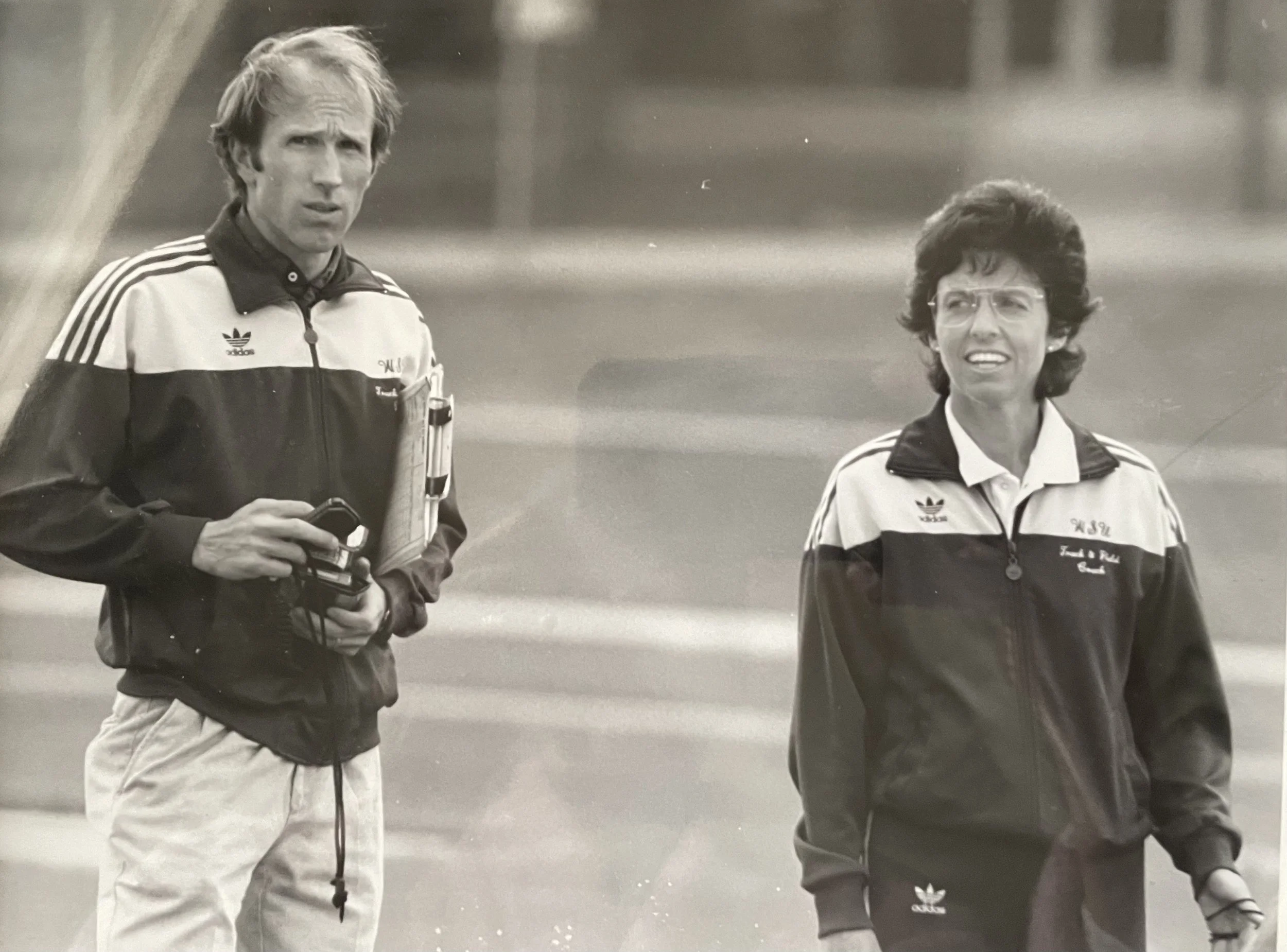
Dragičević Cassleman’s involvement in running began much earlier, through an Armistice Day event for children of British descent organized by a local British club in Chile. “They would have all these activities for kids,” she explained, “Thread the needle, run with a hard-boiled egg, sack races. One year, my sister and I did it, and when we got home, my mom was embarrassed because we had won most of the events. So of course,we liked it a lot. We were little, but we always did well. We enjoyed running and just kept doing it. If you have fun, you keep doing it.”
That enjoyment led her to compete for privately funded club teams organized around nationality and built by immigrant communities, a path she followed into her college years. It also shaped her academic direction, prompting her to study physical education as an undergraduate in Chile. In the early 1970s, Chile’s Olympic Committee brought in an internationally renowned coach from Poland, Vladimir Puzio, a coach trusted by multiple countries to prepare elite athletes for the Olympic Games. She was invited to serve as his assistant. Under his guidance, she learned biomechanics, refined technique, and absorbed the principles that would define her career: train for power, not brute strength; train technique and specificity; train the whole athlete, not just the event.
After completing her undergraduate degree, she began traveling, with the help of the presidential scholarship, to study women’s athletics in the CSSR. That plan was abruptly sidelined by the coup that stranded her in the United States.
“About a month had gone by, and I thought, I just need to go back,” she said, “So I started looking for options to pursue. I opened a phone book at the University of Maryland and found the Association of Physical Education, Sports and Recreation. I called and said, ‘I am from Chile. I’m going back. I would like to talk to somebody about the organization of sports in the U.S. and ideas about books on coaching and training.’ And they said, ‘Oh, we have the right person to talk to, the person who is responsible for international activities.”
After a three-hour conversation with Dr. Ray Ciszek convinced her to continue her graduate studies at the University of Illinois. She was accepted with both a scholarship and a teaching assistantship and soon found herself teaching track and field. Her evaluations were strong, and not long after, she received a phone call. The university needed a women’s track coach.
She had no knowledge of American college athletics and little sense of its politics or inequities. She accepted the position for one year, planning to return home afterward. She earned $2,500 a year, while the men’s coach made ten times that. Her team lacked uniforms, facilities, and basic respect. They drove themselves for hours to competitions and returned the same day. Coaches shared beds.
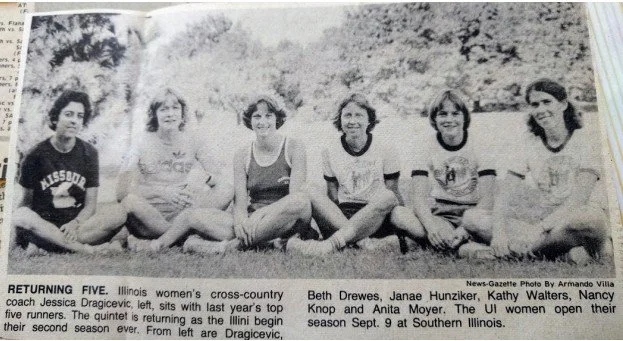
She assumed this was normal. Her athletes knew otherwise. Nessa Calabrese and Nancy Knop decided to file a lawsuit on behalf of student-athletes and coaches at Illinois against the U of I Athletic Association for discrimination against women in the operation of its programs. The suit alleged wide disparities, including spending six-and-a-half times more on men’s sports than on women’s teams, providing financial aid to male athletes while excluding women, and supporting men for five academic years while limiting women to four.
By March 1978, the case was settled. The agreement brought women’s athletics into parity, requiring equal treatment in scholarships and academic support, standardizing eligibility requirements, and increasing funding for women’s coaches and recruitment.
“It really took two athletes on that team, and the support of teammates, to move athletics to a completely different level,” Dragičević Cassleman said. “After filing the lawsuit, without the support of the athletics administration (men or women) the Chancellor at the time, Dr. Gerberding said, ‘We’re not going to court. The changes will happen.’ I was hired as the first full-time coach, and in fact the first full-time coach of any sport at the University of Illinois, because I had incorporated cross-country and indoor track into a year-long program. But it was the athletes who fought for this. They made it happen.”
When she and her husband, Rob Cassleman, then her assistant coach at Illinois, were married in Chile, another phone call arrived. Washington State University was looking for a coach. This was 1982 and there were no cell phones at the time, so the conversation with Marcia Saneholz, women’s athletic director at WSU took place the day they returned to the U.S., they wanted her to visit the following day. “I expressed to her that our U.S. wedding reception was the following Saturday. Can we do it later?” she recalled, “And she responded, ‘Can you come tomorrow?’ So I came that Tuesday, interviewed on Wednesday, and took the first flight back on Thursday. It was an easy decision when the job was offered to me. “When I landed in Spokane and saw the mountains, that decided it for me. I said, ‘even if they offer me the job at low pay, I will take it.’”
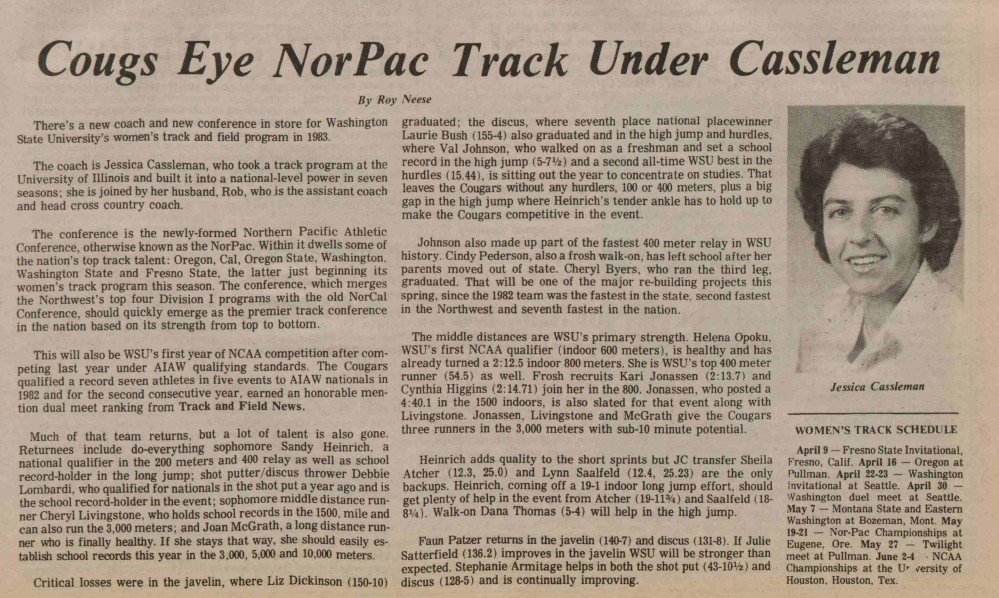
At WSU, she built programs that produced national champions, All-Americans, and teams that competed among the best in the country. Her philosophy never changed: year-round development, individual attention, and respect for the psychological and social lives athletes carried with them onto the track.
Eventually, she stepped away from coaching, choosing family and a different kind of leadership. She became an academic administrator, serving as assistant dean in both the Honors College and the Carson College of Business at WSU, shaping international programs, teaching and mentoring students, and carrying the same principles into the classroom.
Today, her days are quieter, though no less deliberate. She plays tennis at midday, volunteers in the community, and serves local boards. When asked what she is most proud of, she does not point to medals or rankings. Instead, she speaks of letters from former athletes, of influence, of the long view. What matters most, she said, is “seeing the development, the impact you made on the athletes.” It is there, in the cards, that still arrive that she knows there was a positive influence. “That,” she added, “is very important.”
Note about the author: Cara Hawkins-Jedlicka is a longtime supporter of women’s running and is part of the leadership team for Starting Line 1928. She is currently an associate professor of practice at Washington State University in the Edward R. Murrow College of Communication.