Helen Klein
In this episode, you will hear an interview with Eileen Waters Connolly done by Amy Begley as part of the Road Runners Club of America oral history project. It was recorded by phone in 2013.
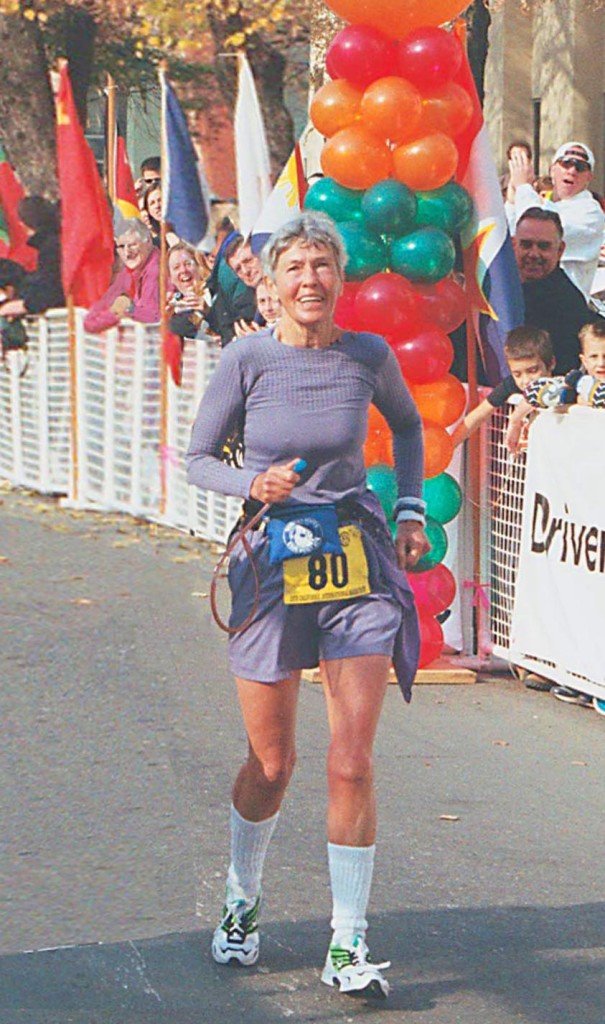
Ultra-running legend Helen Klein turned 100 on November 27, 2022. A force of nature, she believes anything is possible if it is within your grasp. Few people have grasped as many accolades as she has.
Over the course of her remarkable career, Klein amassed 75 national and world records, completed 90 marathons and 143 ultramarathons; and at age 66, was one of the first athletes to complete the Grand Slam of Ultrarunning which consists of four of the most demanding 100-mile trail races in the United States. At 72, she completed a 145-mile race in the Sahara Desert in Morocco. Just weeks later, she finished the punishing 370-mile Echo-Challenge in Utah. She also holds the marathon world record for women aged 80 and over in 4:31:32, which she set at the 2002 California International Marathon. Five years later she shattered the 85 and over record at the same race.
Klein’s running journey started unexpectedly in 1978 at the age of 55 when she decided to accompany her husband, Norm, to train for a 10-mile race. While Norm hit the streets for his training, Klein – too embarrassed to be seen in running shorts – trained on a makeshift track Norm built for her on their eight-acre property. Within ten weeks she could run ten miles. She ran the race, came in last, and swore off running.
That resolve didn’t last. When Norm decided to run marathons, she joined him. Together they tackled their first 50-miler, followed by their first Hawaiian Ironman Triathlon which she completed at age 60, even after her swim coach confided in Norm that, “she didn’t have a snowball’s chance in hell to finish.”
Klein credits her parents with her “can do” attitude. The family motto - always do your best – became the foundation of her life philosophy. Over time, she added desire, discipline, and dedication to form her personal mantra. A first-grade traumatic experience also stayed with her and taught her perseverance. Naturally left-handed, she was forced to learn to write with her right hand, enduring humiliation and being hit with a ruler until she learned to use her right hand. The experience left a lasting mark; to this day, she dislikes writing.
Before her running career took off, Klein was a stay-at-home mother to her four kids. Once they were in school, she became an emergency room nurse. Her medical training proved invaluable during her ultra-runs and the Echo challenge in Utah.
Klein's first attempt at the legendary Western States 100 ended in failure. Undeterred, she returned the following year and finished in 29:19, declaring, “Not bad for a great-grandmother!” She was so taken with the race that in 1986 she and Norm became its race directors. But she wasn’t about to hang up her running shoes. At age 66, she finished the Western States 100, the Vermont 100, Colorado’s Leadville 100, and the Wasatch 100, becoming the oldest woman to complete the Grand Slam of 100-mile trail runs. Finally, she cried, “Never again!”
Despite her extraordinary accomplishments, Klein insists she is not special. “There’s no limit to what a person can do as long as there are no health problems to hinder them,” she explains. “Before I tackle something I have to believe in my heart and mind that there is a possibility of finishing.”
Those close to Klein speak of her mental toughness, describing her as a rare breed. Klein, however, sees herself differently. “What I do is natural to me. Exercise slows down the aging process but as we age, we need to be challenged and stay motivated, always pushing the boundaries. That’s my secret.” She is also an advocate for a healthy and active lifestyle. In her motivational speeches she encourages everyone, regardless of age, to eat a healthy diet and exercise every day, even if it is going for a walk.
She follows her own advice, maintaining a disciplined weekly routine. She rises at 4:30am for a hot tub soak followed by her morning cup of coffee before heading to the gym for weight training and stretching. When training for a 100-miler she’d run back-to-back 20 milers on the weekends. She avoids processed foods and bakes her own bread.
Klein was sponsored by Saucony for several years, running in their Lady Jazz model. Under Saucony’s sponsorship she ran on the international circuit. “I got to see the world thanks to Saucony,” she recalls. But when Saucony changed the design of her favorite running shoe, she couldn’t run in it and ended the contract.
Klein retired from racing at age 88, feeling overwhelmed by the growing publicity that followed her everywhere. Naturally shy, she was uncomfortable with the media attention and public speaking requests. “The press is everywhere I go,” she explained. “This makes me uncomfortable as I was taught to be low profile.” When she was one of the recipients at a 1995 Award for Courage in Sports ceremony, she met a young woman who had lost a child in the Columbine High School shooting, was recovering from brain surgery, coached soccer and was raising funds to build a new school library. “People like her are more inspiring than I can ever be,” said Klein.
Reflecting on her long career, Klein once joked, “When I was young, I ran all of those races by being the tortoise – going slow uphill and fast on the downhill and the flats. Now, I’m the tortoise all the time–slow uphill, slow downhill, and slow on the flats.”
She adds, “I’ve had a great life and I am very grateful.”
Note about the author: Gail Waesche Kislevitz is an award-winning journalist and the author of six books on running and sports. She was a columnist for Runner’s World for fifteen years and her freelance work has appeared in Shape, Marathon and Beyond, and New York Runner.