Tish Hamilton
If Tish Hamilton is being honest, she doesn’t consider herself a pioneer in women’s running. She looks at titans of the sport like Kathrine Switzer and activists like Alison Mariella Desir—“They’re legit,” Hamilton says. But Hamilton’s work in the sport, she was the first female executive editor of Runner’s World magazine, is nothing to sneeze at.
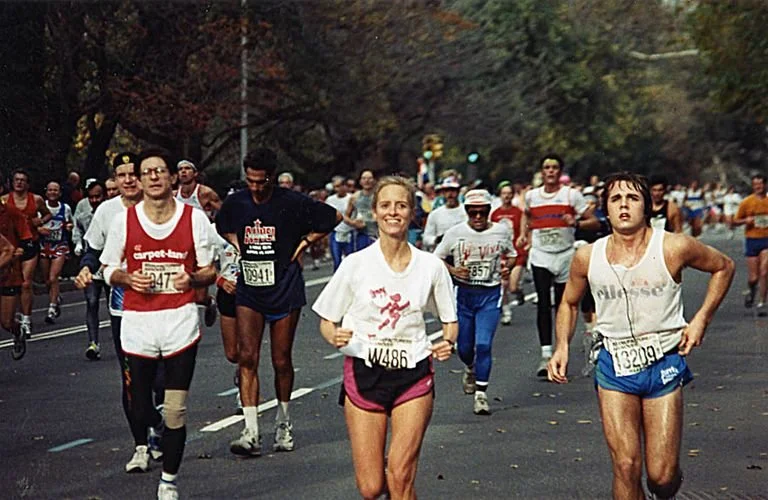
Tish running the NYC Marathon 1989
Hamilton began running in high school, in Atlanta, Georgia. She was probably the slowest runner, but she loved the community and the bus rides to track meets. The Peachtree Road Race, a famed 10K race held on July 4, was also in the back of her mind as a race she might run someday.
Hamilton moved to New York City to attend Barnard College, the women’s college of Columbia University, where she studied English. In 1986 she graduated and wanted to try her hand at magazine writing.
“I thought working in magazines would be fun so I applied to a bunch of magazines,” Hamilton says. She had two offers from which to choose: an assistant in the advertising department of The New Yorker (“Yes, kids, the New Yorker!”) and a receptionist at a children’s publishing company, which had titles like Muppet Magazine and Barbie Magazine. She chose the latter because she’d have a chance to work with the editorial department. (The New Yorker would never let someone from advertising cross the threshold into editorial.)
It was around this time that Hamilton saw ads for a women’s “mini-marathon” in Central Park—one loop for 6.2 miles (10K). It was a mini-marathon because women surely couldn’t run a marathon.
“It was a big deal to run six whole miles,” Hamilton says. She went on to run the Peach Tree Road Race shortly after.
Hamilton eventually hopped over to Rolling Stone magazine where she spent many years moving up the masthead, finally into a managing editor position. Here, she met David Willey, who she sent down the hall to Men’s Journal. From there he would go on to become the editor-in-chief of Runner’s World leading a rebrand of the publication.
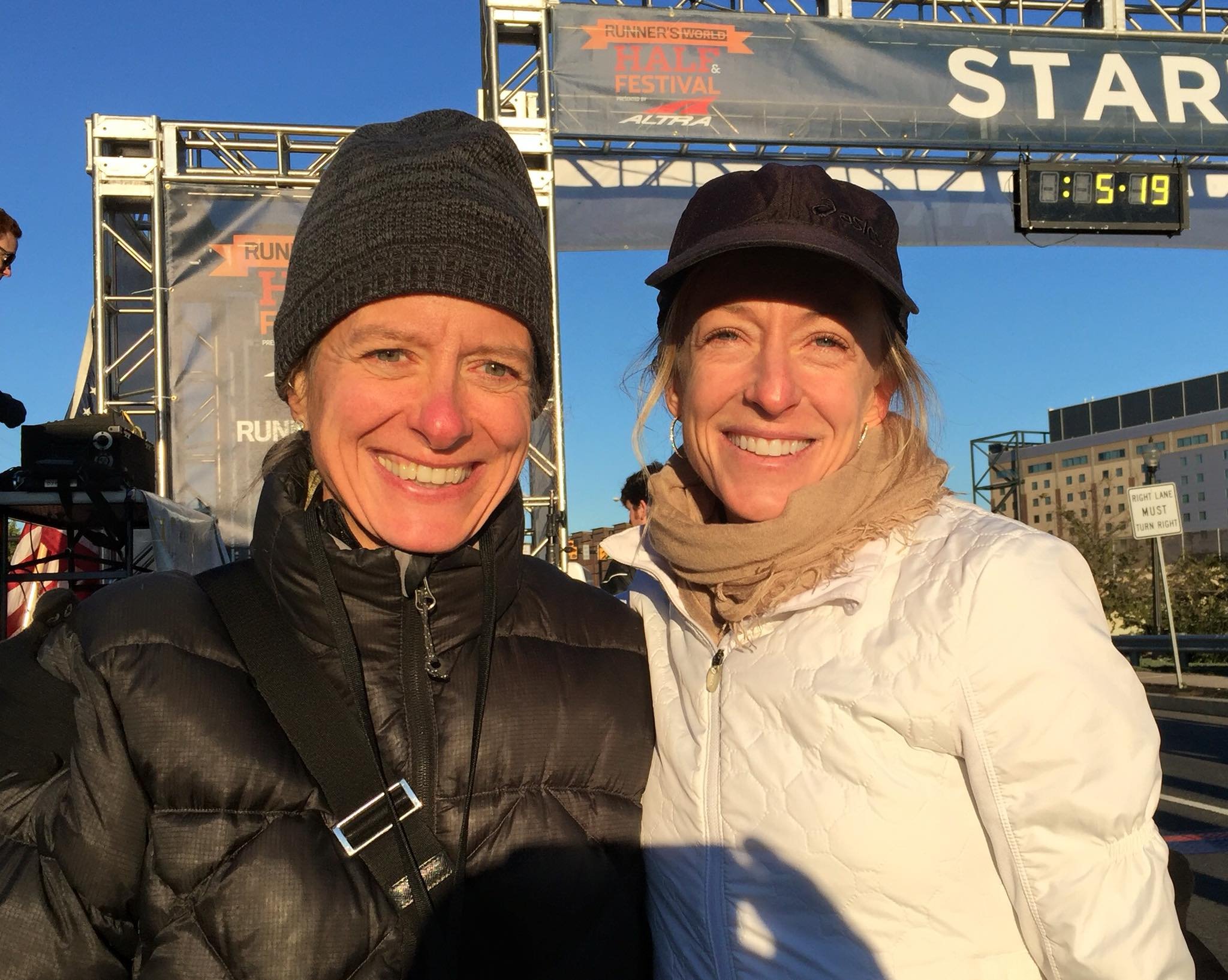
Tish with Deena Kastor
“Yes, David Willey, your career is all thanks to me,” Hamilton laughs. “He knows that I claim him.”
Over the years, Hamilton worked at other big-name magazines, including Outside and the short-lived Sports Illustrated Women. When Sports Illustrated Women folded, Hamilton called Willey who was building a team at Runner’s World. She became the brand’s first woman to hold the executive editor spot, a position which she held from 2003 until 2017.
Hamilton calls the marriage of her two passions—running and journalism—a privilege. She helped usher in the second running boom, one driven largely by women, one step behind the
helm of the go-to magazine for runners. The mission was to broaden the coverage of the sport—from elites to weekend warriors doing incredible work—and with that, bring in a more varied audience, including women.
Being a woman in a sea of men wasn’t an “uncommon feeling” for Hamilton, who’d grown up in a sport that didn’t have many women, and landed herself in an industry that was run by men. She recalls her first marathon, the 1989 New York City Marathon, in which she was one of 5,000 women out of some 25,000 participants (in 2025, 46 percent of the finishers were women).
Hamilton took the (rare) opportunity as a decision-maker to not only hire more women editors (Editor’s note: Heather Mayer Irvine was one of Hamilton’s hires, in 2016), but to elevate women’s stories.
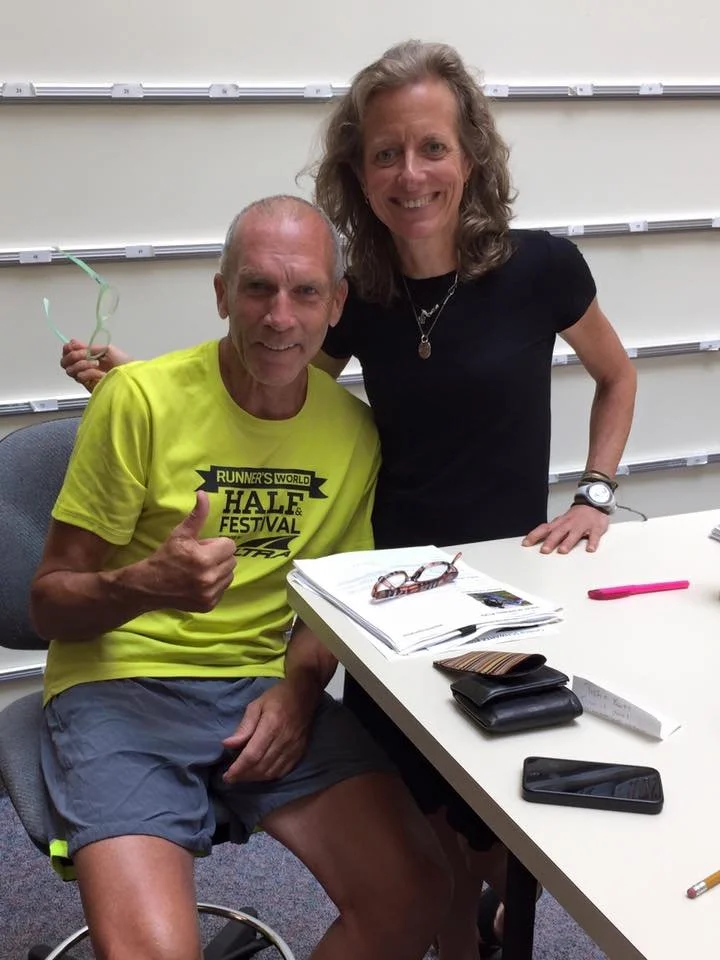
Tish with Bart Yasso
“There are plenty of men on staff to pay attention to stories about men, so let’s have someone who can pay attention to stories about women,” she says. “That is something that sticks with me today.”
There is no one game-changing story that Hamilton wrote or assigned or edited that changed the trajectory of the coverage of women’s running. “There are a lot of moments along the way,” she says, not unlike women’s involvement in the sport.
Hamilton says what she and the magazine could have done better under her tenure is the coverage of women runners of color.
“I wish we had covered more women of color in a way that wasn’t like, ‘Oh my God, there are women of color running!’” she says. “[I wish it had been] more organic and just telling stories and having stories of different kinds of women…and they happen to not be white.”
Today, Hamilton is a professor of writing, and until recently was a co-host of Another Mother Runner podcast. She still runs regularly.
Running “is just a part of my life…it grounds me. I feel off on the days I don’t run,” she says. “I do enter races, like the Every Woman’s Marathon, but I’m not in it for a time goal anymore. It’s just a thing I love to do…Obviously one day I’m not going to be able to run anymore, but I’m hoping to put that off as long as possible.”
Note about the author: Heather Mayer Irvine is the former food and nutrition editor for Runner’s World and the author of the Runner’s World Vegetarian Cookbook. She is an avid runner who has been covering running, nutrition, and health for more than two decades. Mayer Irvine’s work has appeared in Runner’s World, Men’s Health, Outside, and Scholastic. She is based in Pennsylvania with her husband and three kids. IG: @runsonfuel